
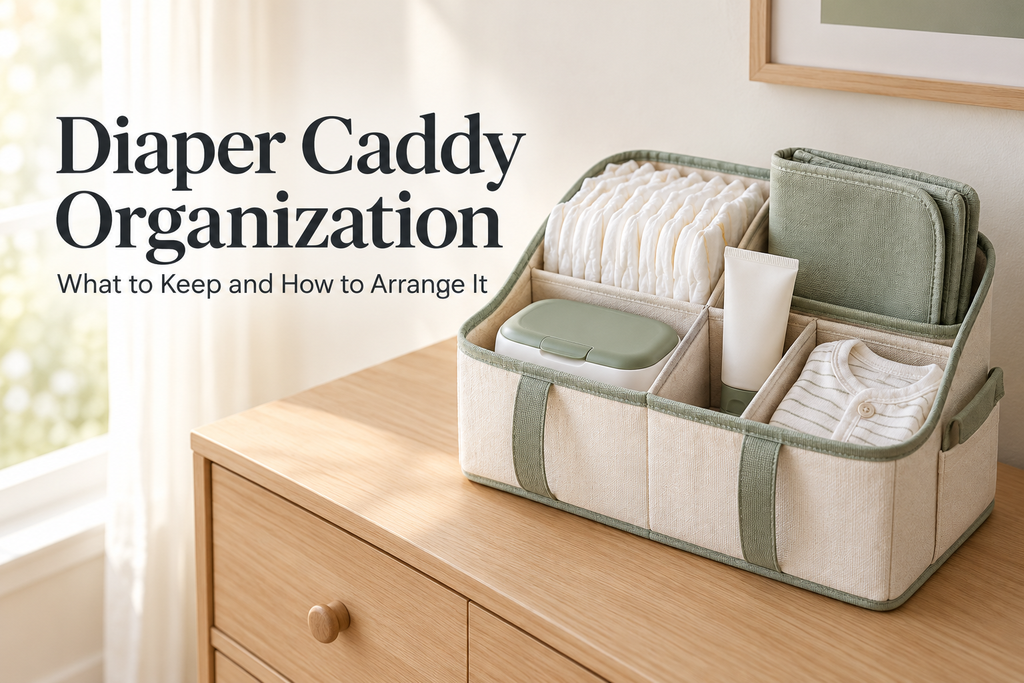
The wipes packet has three wipes left. The spare diapers are in another room. And the clean outfit you thought was nearby has somehow joined the laundry pile. None of these is a major problem on its own, but they become considerably less convenient when a diaper change is already underway.
A thoughtfully arranged diaper caddy gives those everyday essentials a predictable home. You can see what you have, reach what you need, and spot what needs replacing before the next change. It can also make it easier for your partner, a grandparent, or another caregiver to step in without searching through drawers.
You don’t need an elaborate setup. A suitable basket or organizer you already own may work perfectly well. What matters is what you put inside, how you arrange it, and where you keep it.
Start With Your Everyday Changing Routine
Before filling a caddy, think about where you usually change your baby and which supplies you reach for most often.
Do you have one main changing area? Do you regularly use a second space during the day? Are you using disposable diapers, cloth diapers, or a combination?
These details help you decide what belongs in your setup. A caddy that moves between rooms may need a folded changing mat. One beside a permanent changing station might leave the mat outside the basket and use that space for spare clothing.
Keep enough supplies to cover the changes you expect before your next refill. The right quantity will depend on your baby and your routine. Bulk supplies can stay in a cupboard or drawer nearby.
What to Keep in a Diaper Caddy
Start with a small collection of useful items, then adjust as you discover what you actually use.
Diapers in your baby’s current size
Keep a manageable supply of clean diapers together. Stand disposable diapers upright or arrange them in a short stack so you can remove one without disturbing everything else.
If you use cloth diapers, keep clean diapers and any covers or inserts needed for your usual setup together. Store used cloth diapers separately in your designated diaper pail or wet bag.
Check the size when you refill. It’s easy for a few outgrown diapers to linger at the bottom of a basket.
Wipes with a secure closure
Place wipes where you can reach them easily, with the opening facing upward and clear of other items.
Keep the packet or dispenser closed between changes to help prevent the wipes from drying out. Check how much is left rather than relying on a packet that still looks full from the outside.
Diaper cream, if you use it
If diaper cream is part of your baby’s care routine, give it a small, consistent place in the caddy. Keep it in its original container, close it securely, and follow its directions.
You don’t need several creams competing for space. Keep the product you currently use accessible to the adult and beyond the child’s reach.
A clean changing mat, where needed
A folded portable mat can be useful when your caddy moves between changing areas. Choose one that fits comfortably and can be cleaned according to its care instructions.
Avoid packing it so tightly that removing it pulls out half the contents. If you have a permanent changing pad, the caddy may not need an additional mat.
One spare outfit
A clean bodysuit or simple outfit can be useful after a leak. Fold it into a separate compartment or small clean pouch so it stays together.
Choose clothing that currently fits your baby. A neatly folded newborn outfit won’t be much help once your child has outgrown it.
Optional items that fit your routine
Depending on your needs, you might also include:
- A spare changing-pad cover.
- Clean cloth wipes, if you use them.
- An additional cloth-diaper insert or cover.
Add these because they serve a purpose in your home. If an item repeatedly goes unused, move it elsewhere.
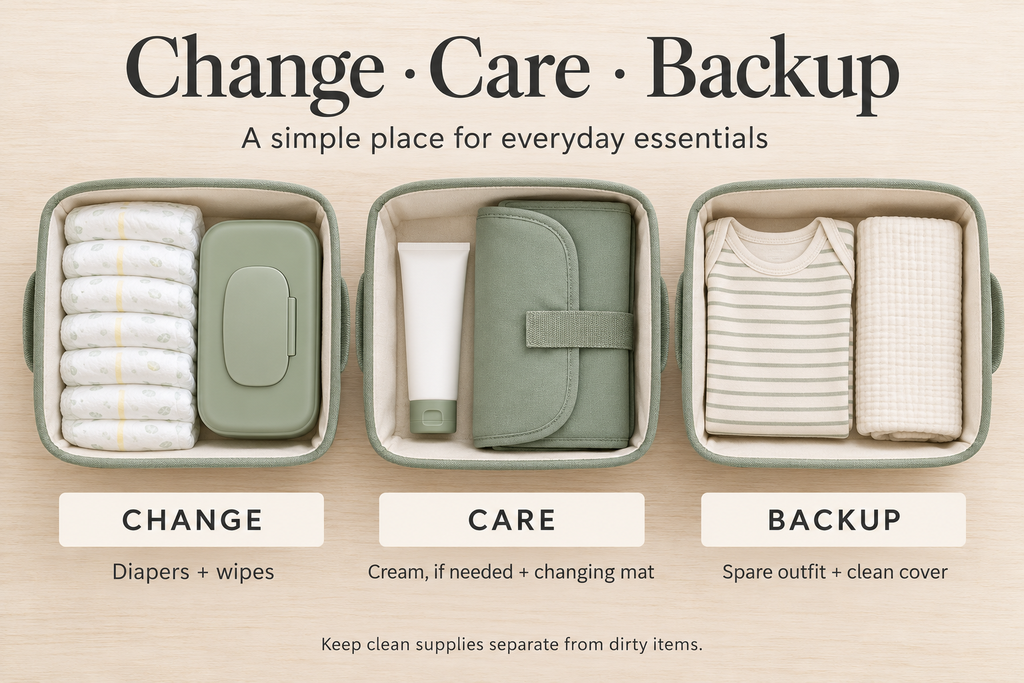
Arrange the Caddy in Three Simple Zones
You don’t need a large organizer with numerous pockets. Three clear groups can make even a basic basket easier to use.
1. Change: diapers and wipes
Give diapers and wipes the easiest access because you’ll use them during most changes.
In a divided caddy, the largest section might hold diapers, with the wipes beside them. In an undivided basket, place the diapers along one side and the wipes on the other.
The wipes opening should remain unobstructed. You shouldn’t have to lift clothing or remove the changing mat to reach it.
2. Care: cream and changing mat
Use a smaller section for securely closed diaper cream and a folded mat, if needed.
Keep the cream upright where possible. Position the mat so you can lift it out without knocking over other supplies.
3. Backup: spare clothing and replacements
Keep your spare outfit and any clean replacement cover together in the remaining space.
These items can sit toward the back because you may use them less frequently. They should still be visible and easy to retrieve when needed.
Change · Care · Backup is an organization idea you can adapt to your container. The exact compartment sizes matter less than having a consistent place for each item.
What to Store Elsewhere
A caddy works best when it has a clear job. Filling it with every baby accessory makes the essentials harder to find.
Store bulk diaper packs and unopened wipes separately, then use them to replenish your everyday supply.
Other items are better kept elsewhere:
- Medicines and supplements: in appropriate secure storage, following their storage instructions.
- Cleaning sprays and disinfectants: away from the baby and clean changing supplies, securely out of children’s reach.
- Scissors, nail clippers, and small accessories: in a separate, secure place.
- Feeding supplies and snacks: away from the diaper-changing area.
- Dirty diapers and soiled clothing: in appropriate separate containers, never mixed with clean caddy contents.
CDC guidance recommends keeping dirty diapers and clothing away from surfaces that cannot be easily cleaned. A separate place for soiled items helps maintain that separation during a change.
Put the Caddy Within Your Reach
A well-organized caddy is useful only if it is in the right place.
The American Academy of Pediatrics recommends keeping diapering supplies within the caregiver’s reach but outside the child’s reach, so there is no need to leave the baby’s side to fetch them.
Before starting a change, check that the supplies you need are accessible. Keep the caddy on a stable surface, away from edges, without crowding the space where your baby lies.
Never leave your baby unattended on a raised changing surface. Keep a hand on your child during the change, and remember that an organized basket cannot replace supervision.
If you carry the caddy between rooms, set it down and prepare the changing area before beginning. Afterwards, return it to a suitable place beyond children’s reach.
Choose a Container That Is Easy to Use
If you already have a suitable organizer, try it before buying another.
Look for enough room to keep essentials visible without wedging them together. Dividers can help, but too many narrow pockets may make bulky items awkward to store.
If you plan to move the caddy regularly, consider whether its handles feel secure when loaded. Check its cleaning instructions too. Fabric and woven containers may need different care from wipe-clean plastic organizers.
A caddy that photographs beautifully may still be frustrating if it collapses around the wipes or hides small items at the bottom. Let your daily routine guide the choice.
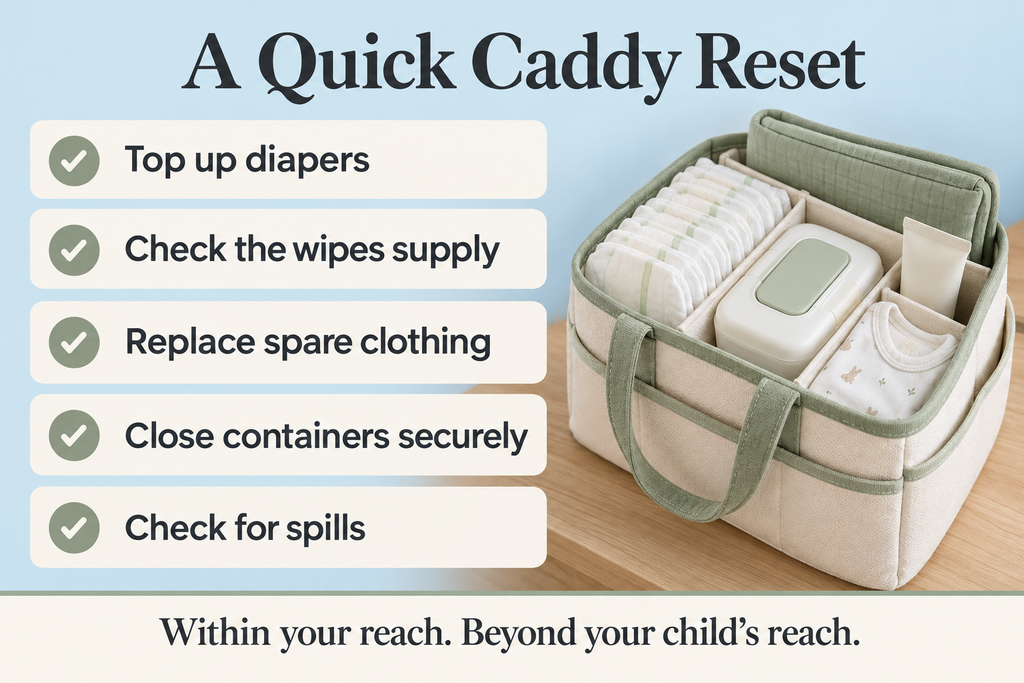
Make Refilling Part of a Small Reset
Choose an easy moment to check the caddy—for example, when preparing the changing area for the evening.
A quick reset can include:
- Topping up diapers.
- Checking the wipes supply and closing the lid.
- Replacing any spare clothing you used.
- Checking that cream containers are closed and not leaking.
- Removing items that no longer fit or belong there.
Clean the caddy according to its material and care instructions, and address spills promptly. If clean supplies become soiled, remove them rather than putting them back among the remaining contents.
The caddy also supports only one part of changing hygiene. CDC guidance recommends washing your child’s hands and your own hands after a diaper change, as well as cleaning the changing surface.
Common Diaper Caddy Organization Mistakes
Packing it too tightly
When every compartment is full, taking out one diaper can pull out several other items. Leave enough space to remove supplies comfortably.
Burying the wipes
Wipes belong near the top, with the opening clear. If you routinely move other items to reach them, adjust the layout.
Letting the caddy become a general storage basket
A pacifier, a hairbrush, a toy, three toiletries—extra items can accumulate quietly. Review the contents occasionally and return unrelated items to their usual places.
Forgetting the spare outfit
Check both whether it is clean and whether it still fits. Replace it after use instead of assuming someone else has already done so.
Creating a system only one person understands
Keep the arrangement simple enough for another caregiver to use. Brief labels can help if your household finds them useful, but a clear layout may be sufficient.
A Quick Diaper Caddy Check
Before the next change, ask:
- Are there enough clean diapers in the current size?
- Are the wipes stocked and easy to reach?
- Is any cream securely closed and accessible to the adult?
- Is the changing mat or pad clean and ready?
- Is the spare outfit clean and the right size?
- Is there a separate place for dirty diapers and soiled clothing?
- Can I reach everything without leaving my baby?
You’ll probably adjust the setup as your baby grows and your routine changes. That’s normal. Give the essentials a consistent home, keep clean and dirty items separate, and refill before supplies run out. A useful caddy is one that makes the next change easier.
Heading out with your baby? Read our guide to diaper bag essentials parents actually use.