
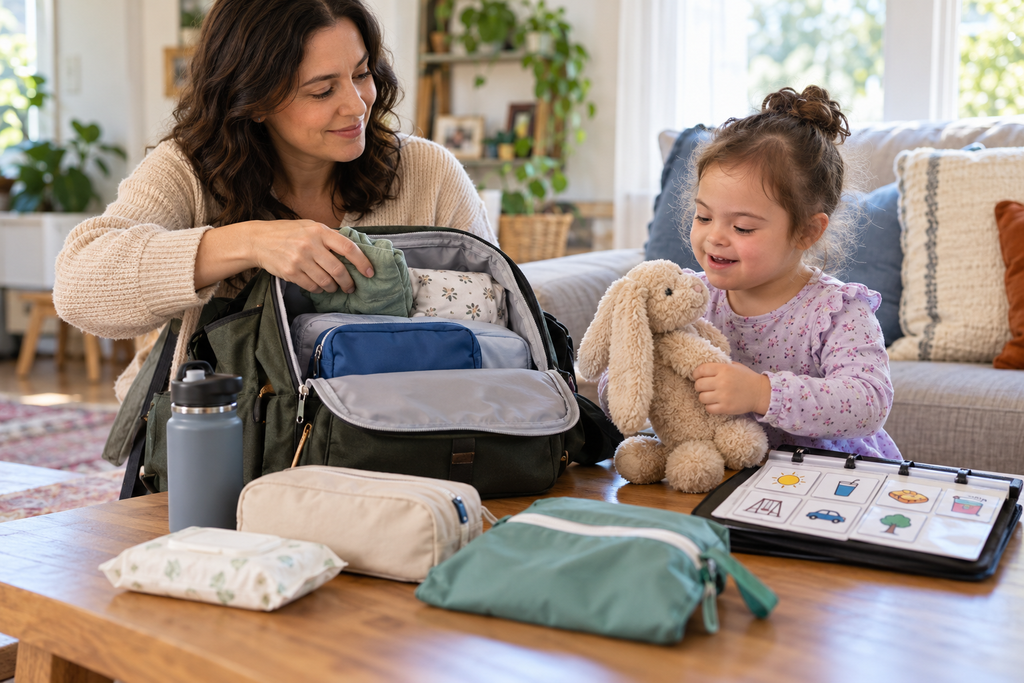
Leaving the house with a child can sometimes feel like preparing for a small expedition.
You pack the changing supplies, wipes, snacks, spare clothes and perhaps a favorite toy. Then, five minutes after leaving home, you remember the one thing you actually needed.
For parents and caregivers of children with special health care needs, preparing for an outing can involve another layer altogether.
Depending on the child, leaving home might mean bringing medication, feeding supplies, communication supports, sensory items, mobility equipment or additional changing supplies. Even something as ordinary as visiting family, going to a restaurant or spending an afternoon at the park may require careful preparation.
Research involving families of children with medical complexity identifies physical and environmental barriers to mobility and participation. Research involving caregivers of autistic children also shows that sensory environments can influence participation in everyday activities.
But this does not mean you need to carry half the house every time you go out.
A better approach is to pack around one simple question:
What does my child actually need to be safe, comfortable and supported while we are away from home?
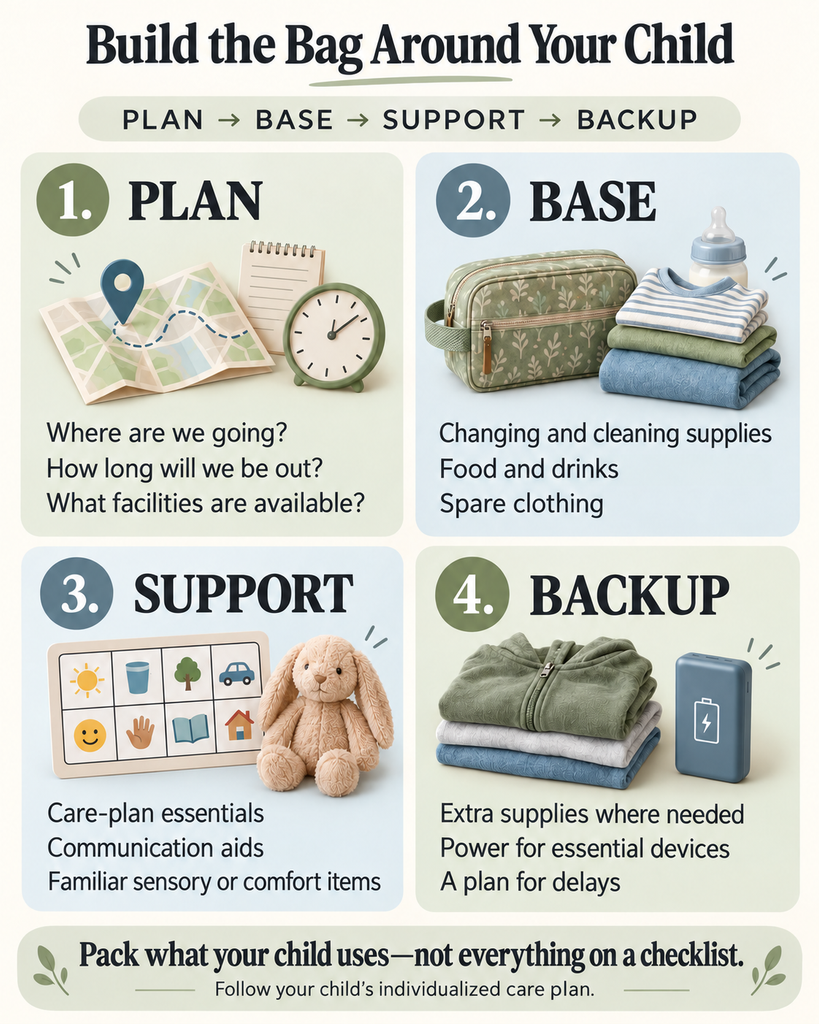
The PLAN → BASE → SUPPORT → BACKUP approach can help answer that question.
1. PLAN: Think About the Outing Before Packing the Bag
Before deciding what goes into the bag, think about where you are going.
A two-hour visit to a relative’s house may require very different preparation from a full day at a busy shopping center.
Consider the length of the outing, where your child can be changed or use the toilet, whether feeding or medication will be needed, and whether the destination is accessible for any stroller, wheelchair or mobility equipment your child uses.
For a child who sometimes needs a quieter environment, it can also help to know whether there is somewhere to take a break.
And if your child relies on an electronic device, ask another simple question: Will we have enough battery power for the entire outing?
Research with caregivers of autistic children has found that parents often develop strategies around their child’s individual needs, including adapting activities and environments to make participation more manageable.
Planning will not make every outing predictable. It simply reduces the number of problems you may have to solve after leaving home.
2. BASE: Start With the Everyday Essentials
Before thinking about additional supports, start with the ordinary things your child uses during an outing.
Depending on your child’s age and needs, these might include diapers, pull-ups or other changing supplies, wipes, a changing mat, spare clothing, appropriate food and drinks, bibs, hygiene supplies and disposal bags.
Having additional needs does not make ordinary parenting needs disappear.
One practical approach is to divide these basics into the same CHANGE–CLEAN–FEED system we use in our general diaper-bag guide.
CHANGE covers diapers, pull-ups or other continence supplies where applicable, wipes and changing necessities.
CLEAN covers spare clothing, wet bags, tissues and cleanup supplies.
FEED covers appropriate food, drinks, bottles, bibs or other everyday feeding supplies.
Keeping these groups together in separate compartments or small organizers can also make important items easier to find when you need them quickly.
Then comes the more individualized part of the bag.
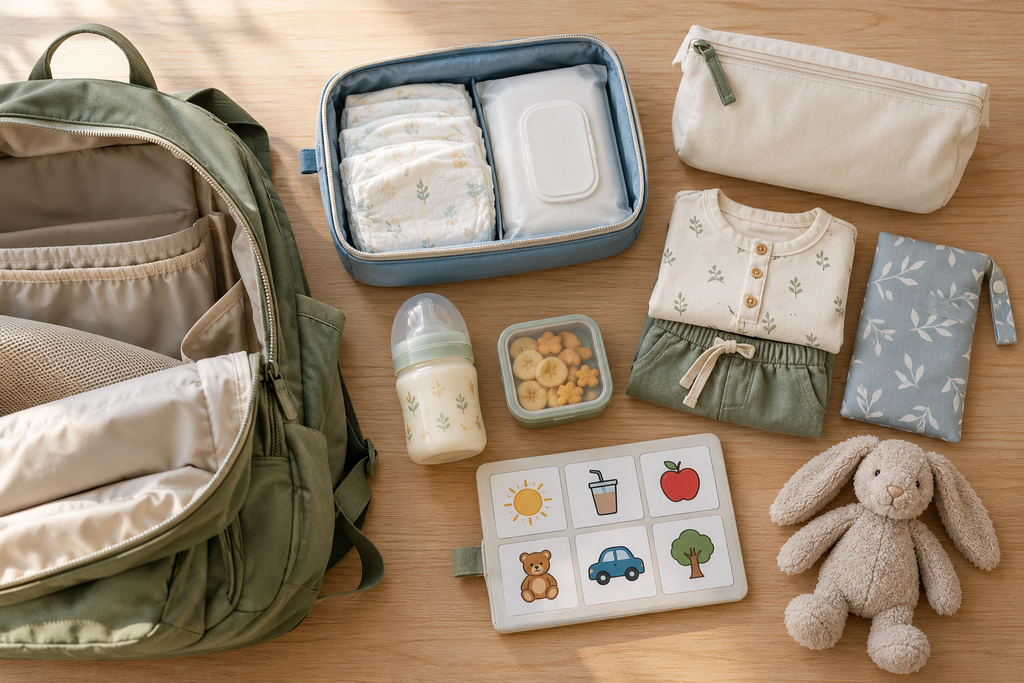
3. SUPPORT: Pack for Your Child, Not a Diagnosis
There is no universal “special-needs diaper bag.”
Two children with the same diagnosis may still have very different daily needs.
Instead of packing everything a child with a particular condition might need, concentrate on the supports your own child regularly uses.
Medication and health-related supplies
If your child needs medication or other health-related supplies while away from home, give them a dedicated and appropriate place among your outing essentials.
Follow the storage, dosage and administration instructions provided by your child’s healthcare team or pharmacist. Some medicines have particular storage requirements.
CDC preparedness guidance for children with special health care needs emphasizes considering medications, medical supplies and storage requirements when planning for a child’s needs.
An ordinary family outing is different from preparing for an emergency, so the objective is not to turn your diaper bag into a disaster kit.
The useful principle is much simpler:
Know what your child’s care plan requires while you are away from home, and make those essentials easy to locate.
Keep important information accessible
Depending on your child’s circumstances, it may also be useful to have essential care information accessible if another adult or healthcare professional needs it.
That could include relevant medical information, medication details, allergies, emergency contacts and important care instructions.
CDC guidance similarly recommends maintaining current medical and care-plan information when preparing for the needs of children with special health care needs.
For an everyday outing, this might mean a concise paper copy kept securely or appropriate information available offline on your phone.
There is no reason, however, to carry more sensitive information than is necessary.
4. Think Beyond Snacks When Packing Feeding Supplies
For many children, packing something to eat and a bottle or cup is straightforward.
For others, feeding away from home can require more preparation.
A child might need familiar foods, specialized formula or child-specific feeding equipment.
Pack according to your child’s established feeding plan rather than adding products simply because they appear on a generic checklist.
Also think beyond the food itself.
Where will feeding happen?
Will you need somewhere suitable to sit?
Will any equipment need to be cleaned afterward?
How will anything requiring temperature control be stored appropriately?
The objective is not simply to have food inside the bag. It is to make the next feeding manageable when you are away from your normal setup.
5. Bring Familiar Sensory and Comfort Supports
A busy restaurant that seems ordinary to one child might contain bright lights, loud conversations, unfamiliar smells and constant movement that another child finds difficult to manage.
Research involving caregivers of autistic children has found that sensory characteristics of an environment can affect participation and that parents often develop specific strategies to make activities more manageable.
If sensory support is relevant to your child, think about what already works.
Depending on the child, that could mean a familiar comfort object, favorite small toy, preferred activity, communication device or appropriate hearing protection.
The important word here is familiar.
An outing is generally not the ideal time to discover whether a completely new calming product works for your child.
Where possible, start with supports your child already knows and uses.
6. Treat Communication Supports as Essentials
Some children communicate using picture cards, communication boards, sign language, tablets or other augmentative and alternative communication methods.
If your child relies on a communication aid, treat it as an essential part of the outing rather than an optional extra.
For an electronic communication device, check the battery before leaving and consider how long the outing is expected to last.
CDC preparedness guidance includes backup-power considerations for communication devices and other necessary electronics.
For an ordinary trip, applying that principle may be as simple as charging the device before leaving or carrying an appropriate charger when necessary.
7. Plan Ahead for Changing and Toileting
Baby changing tables are designed for babies.
That can become a significant practical problem when an older or larger child still requires assistance with changing or toileting.
Research involving caregivers of children with medical complexity has identified a need for more inclusive facilities, including adult-sized changing tables.
Checking the facilities at your destination can therefore be just as important as packing the bag.
Where appropriate to your child’s needs, changing supplies might include continence products, wipes, a suitable portable changing surface, spare clothing, disposal bags and a wet bag for soiled clothes.
However, equipment inside your bag cannot solve every accessibility problem.
Sometimes the most useful preparation is simply knowing what facilities are available before leaving home.
8. Remember That Not Everything Fits in a Diaper Bag
Some outings involve much more than a bag.
A child may use a wheelchair, walker, specialized stroller or medical equipment that needs to travel separately.
In those situations, the question changes from:
“What fits in the bag?”
to:
“What needs to travel with us?”
Think about loading and unloading, accessible parking, entrances, available space and power requirements where relevant.
Transportation safety is particularly important. The American Academy of Pediatrics provides guidance on transporting children with special health care needs and securing equipment appropriately during vehicle travel.
Do not improvise ways of securing medical or mobility equipment in a vehicle. Follow the equipment manufacturer’s instructions and guidance from appropriate healthcare, mobility or transportation professionals.
9. BACKUP: Prepare for the Small Things That Go Wrong
Once the essentials are packed, ask one final question:
What happens if something important doesn’t work as expected?
A diaper leaks.
Clothes become wet.
A feeding takes longer than expected.
A battery runs low.
You stay away from home longer than planned.
A familiar comfort item gets dirty.
The answer is not necessarily to pack two of everything.
Instead, identify the few problems that would make continuing the outing genuinely difficult.
Depending on your child’s needs, sensible backup preparation might mean another outfit, additional changing supplies, an appropriate charger, extra feeding consumables or another child-specific essential.
The aim is useful redundancy, not over-packing.
Don’t Forget the Parent or Caregiver
There is another person involved in all this preparation: you.
Research examining caregiver participation shows that community outings can involve considerable planning, adaptation and vigilance for caregivers of children with additional needs.
So leave a little room for yourself.
Water, a small snack, phone charger, tissues and whatever personal essentials you normally carry may seem insignificant, but an outing becomes considerably harder when the caregiver is also uncomfortable or unprepared.
When practical, sharing responsibilities with another trusted adult can also make more complicated outings easier to manage.
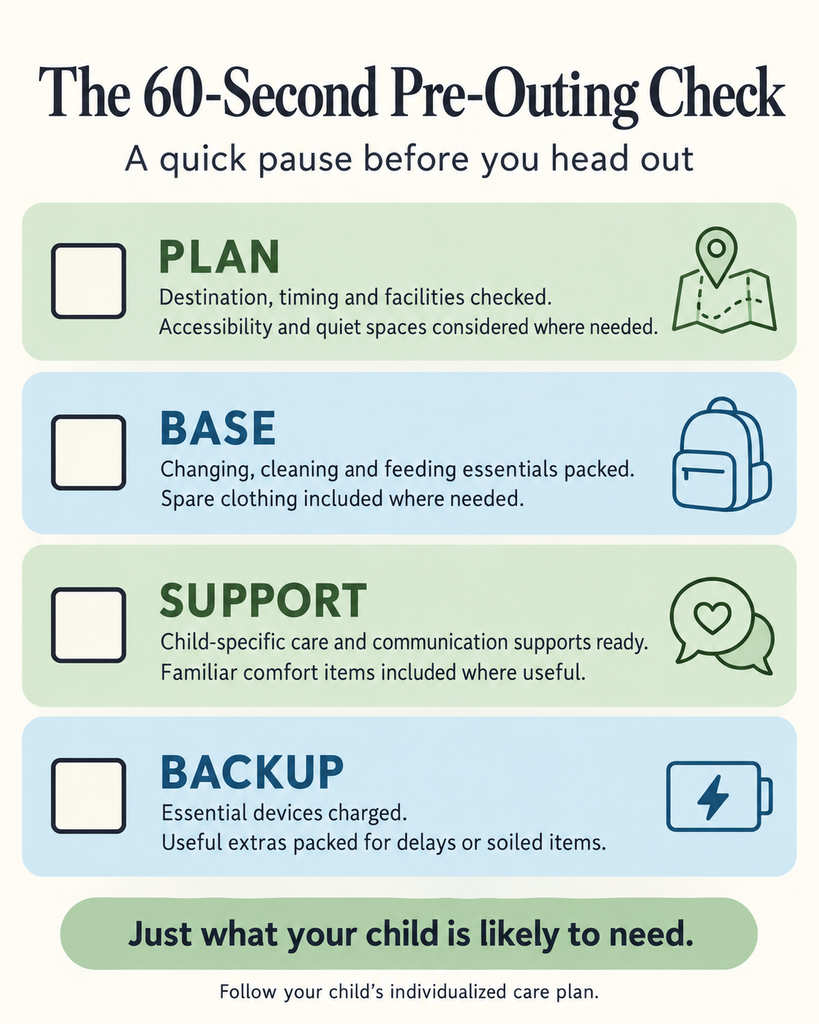
The 60-Second Pre-Outing Check
Before walking out the door, run through four words:
PLAN — Where are we going, how long will we be there and what facilities are available?
BASE — Do I have the everyday changing, cleaning, feeding and clothing essentials my child needs?
SUPPORT — Do I have the medication, communication, sensory, feeding or other child-specific supports required for this particular outing?
BACKUP — If one important item is used up, becomes soiled, loses power or doesn’t work, am I reasonably prepared?
That’s it.
Not fifty things.
Not every item recommended on the internet.
Just what your child is likely to need.
The Best Bag Is the One Built Around Your Child
Parents and caregivers often become remarkably skilled at anticipating what an outing might require.
Research into caregiver experiences reflects exactly that: families develop strategies, adapt environments and make decisions about where and how their children participate in community life.
A well-packed bag cannot remove inaccessible facilities, unexpected delays, sensory challenges or every other difficulty a family might encounter.
But it can remove some unnecessary friction.
Start with the ordinary essentials.
Add the supports your child actually uses.
Prepare sensible backups.
And check the destination before you leave.
Because the best outing bag isn’t the one with the most things inside.
It’s the one built around what your child actually needs away from home.
This article provides general organizational and outing-preparation information and is not medical advice. Medication, medical equipment, feeding plans and other health-related supplies should be managed according to your child’s individualized care plan and guidance from appropriate healthcare professionals.
Pingback: How to Pack a Diaper Bag for a Child With Sensory Needs
Pingback: Toddler Straw Cups: What to Check Before Buying