Affiliate disclosure: As an Amazon Associate, I earn from qualifying purchases.
The easiest time to spot a fiddly straw cup is usually after dinner. The cup itself rinses clean, but there’s still milk inside the straw, and you’re trying to work out whether the little piece under the lid is supposed to come off.
Before buying a toddler straw cup, look at the underside of the lid as closely as you look at the outside. A good fit is a cup your child can comfortably hold and sip from, and one you can take apart and wash without a struggle.
A quick toddler straw cup buying checklist
| Grip and size | Can your child lift it when it’s full? Handles can help if the cup is wide or hard to grip. |
| Straw design | A weighted straw can help if your child tips the cup up to drink. If the straw has a valve, check how it opens. |
| Lid and cover | Look for a clear way to tell when the lid is seated and the cover is fully closed. |
| Parts that come apart | Look for a photo or diagram showing the straw, the underside of the lid, and any removable valve or seal. |
| Replacement parts | Search for a spare straw that fits the exact model, especially if you plan to use the cup every day. |
Weighted straws, valves, and covers do different jobs.
A weighted straw has a weight at the bottom of the flexible tube. As your toddler tips the cup, that end can move toward the liquid. It’s a useful feature if your child still lifts the bottom of the cup the way they would with a bottle. If they already hold a straw cup upright, a straight straw may suit them just fine. The Munchkin Any Angle trainer cup is an example of a weighted design.
A valve helps control when liquid comes through the straw. Check how it opens, especially if your child is used to an ordinary straw. A cover is the part you close between drinks. Depending on the cup, it can shield the straw and help seal the cup. For example, OXO describes how the Transitions straw valve and hinged cap work and specifies that the cap creates a seal when closed.
If you’re buying for a younger sibling as well, the American Academy of Pediatrics’ guide to moving from bottle to cup says families can offer a cup around the time babies start solids, usually around six months. A straw cup and an open cup are both options.
How to tell if a toddler straw cup will be easy to clean
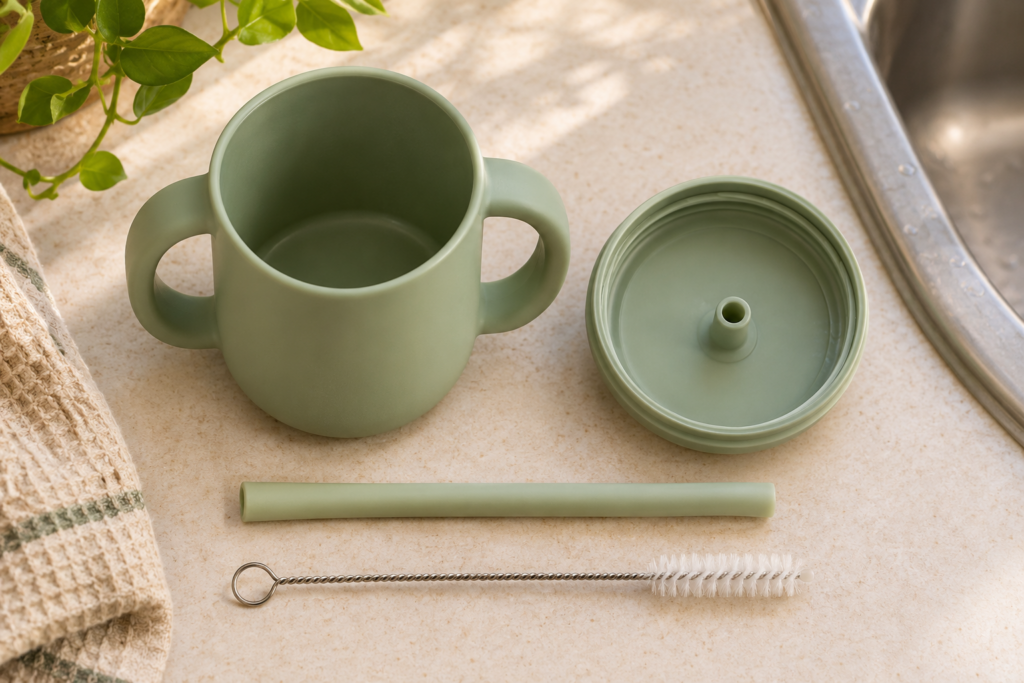
Look for the picture that shows the cup in pieces. The most useful detail is where the straw connects to the lid. Can you pull the straw out and reach the narrow channel with a brush? Is there a groove under the lid where milk could collect? If there’s a seal, check the manual to see whether it’s meant to come out for washing. Some pieces are designed to stay attached.
Check the dishwasher instructions for the exact model. A listing might say “dishwasher-safe” while the instructions specify the top rack or tell you to separate the pieces first. If the cup comes with a brush, check whether the brush fits the entire length of the straw, including any narrow section near the valve.
After use, take apart the pieces the manufacturer says to remove. Wash the straw and any accessible valve, rinse, and let the pieces air-dry before putting the cup back together. The CDC’s guidance on cleaning feeding items includes straws, valves, and cup spouts.
Which cup fits meals, daycare, or outings?
At home, think about what your toddler usually drinks and how often you’ll wash the cup. For a few sips at lunch, a small cup is easier to lift and leaves less to clean up if it tips. If you often serve milk in it, pay extra attention to how easily the straw comes off.
For daycare, check the center’s cup and labeling requirements. Let your child try picking up the filled cup and drinking from it before you send it. If the cover is intended for your child to open, give them a chance to try that, too.
For outings, check whether the handles or lid make the cup too wide for the bag’s bottle pocket. Fill it with a little water, close it as directed, and hold it sideways over the sink to see whether it drips. If you’re deciding where the cup will go alongside everything else, see our guide to packing a diaper bag for a child with special health care needs.
Three toddler straw cups to compare
These examples are based on the manufacturer’s published specifications.
Munchkin Any Angle Click Lock Weighted Straw Trainer Cup, 7 oz
This is the one to look at if your child tends to tip a cup back to drink. The 7 oz version has two handles, a weighted straw, a flip-top straw cover, and a brush. If you’re buying a spare lid, check the finish. Munchkin says the matte and glossy lids use different threading, though replacement straws fit both versions.
See the Munchkin Any Angle 7 oz Weighted Straw Trainer Cup on Amazon (paid link).
OXO Tot Transitions Straw Cup with Removable Handles, 6 oz
This 6 oz cup is worth a look if you want handles your child can use now and remove later. It has a straw valve and a hinged cap. OXO says the lid comes apart for cleaning, so look at the lid diagram to see what you’ll be washing.
See the OXO Tot Transitions 6 oz Straw Cup with Removable Handles on Amazon (paid link).
ezpz Mini Cup + Straw Training System, 4 oz
The ezpz Mini Cup + Straw Training System is a small silicone option for meals. It holds 4 oz, and you can take the lid off to use it as an open cup. The manufacturer lists it for 12 months and up and says it’s dishwasher-safe. If you want a cup that lasts through a long outing between refills, check whether 4 oz is enough.
A few questions before you buy
Does my toddler need a weighted straw? Watch how they already drink. If they keep tipping the cup up and losing access to the water, a weighted straw may help. If they sip comfortably with the cup upright, focus on the grip, lid, and cleaning steps.
Can all the pieces go in the dishwasher? Check the care instructions for the specific cup and take it apart as directed. If you wash the straw by hand, make sure the brush reaches through it.
Can I get a replacement straw? Look up the model name and capacity before you order a spare. Cups from the same brand can have similar names and different parts.