
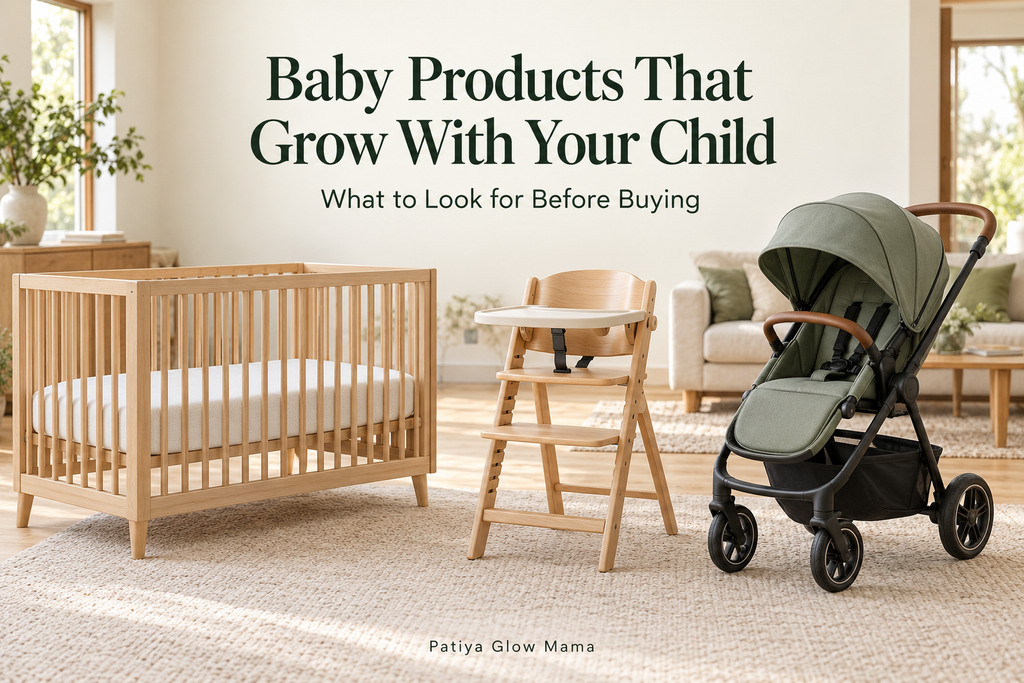
“3-in-1.” “4-in-1.” “From baby to big kid.” Browse baby products for a few minutes and you’ll see plenty of promises about how long one purchase can last. A crib becomes a bed. A high chair takes on another role at the table. A stroller offers different setups as your family’s needs change. It’s an appealing idea: buy something useful now and keep using it later.
The harder part is working out what that promise means in your home. Will you use the later stages? Are the extra parts included? And will a product bought for tomorrow make life easier today? Before giving those future possibilities too much weight, it helps to ask one simple question: Will this still be useful as my child grows—and what will it take to keep using it?
What Does “Grow With Your Child” Actually Mean?
Products can adapt in different ways, so it helps to look beyond the label.
Some are adjustable. You change a seat position, footrest or other setting as your child grows, while the product continues doing the same job.
Others are convertible. Parts are removed or rearranged so the product serves a different purpose, such as a crib becoming a toddler bed.
Some are expandable. They need additional accessories to offer another configuration, such as a compatible attachment for a stroller.
A product may combine these features. The useful detail is what changes, what you need to make that change and whether the new setup would suit your family.
Start With the Stage You Need Today
Future usefulness deserves attention, but the product still needs to earn its place now.
Imagine choosing a stroller because it offers several later configurations, then discovering that its everyday setup is awkward to lift into your car. Or buying a high chair for its eventual use as a child’s chair, while finding the tray frustrating to clean after every meal.
Those daily inconveniences matter.
Before considering the later stages, ask:
- Does this model suit my child’s current age, size and developmental stage?
- Can the adults using it manage the adjustments comfortably?
- Is it convenient for the routines we already have?
- Would I still consider buying it if it offered only its current function?
That last question can help you see how much of the appeal comes from present usefulness and how much comes from an imagined future.
Look Beyond the Number of Modes
A longer list of configurations can make a product look like better value. But your family may only need a few of them.
A convertible crib, for example, may offer a toddler-bed stage you expect to use. Its eventual full-size-bed configuration may be less relevant if you plan to move it into a smaller room or pass the crib to a younger sibling.
The same thinking applies to feeding chairs and strollers. Consider which setups fit your likely routines, rather than assuming every advertised mode will become useful.
Look closely at the conversion itself, too. Read the instructions or watch the manufacturer’s demonstration. Does the change involve a simple adjustment, or does it require tools, several loose parts and somewhere to store what you remove?
A conversion that happens once after several years is different from an adjustment you expect to make every weekend. The effort should make sense for how often you’ll use the feature.
Check What the Full Setup Costs
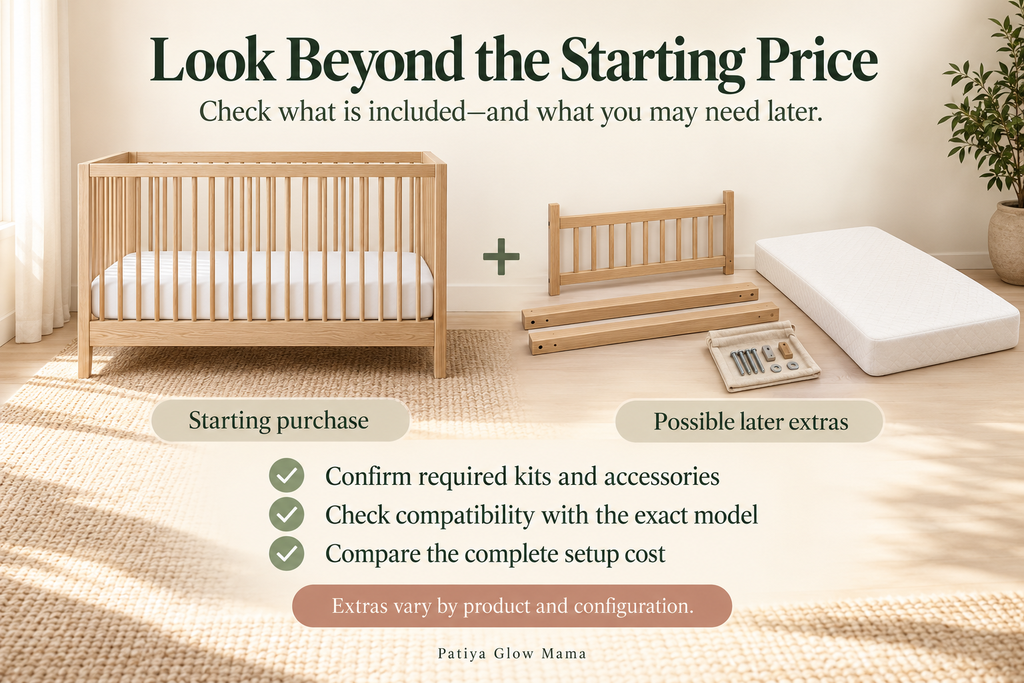
The initial price may cover only part of the product’s long-term promise.
For example, Delta Children’s Tribeca 4-in-1 crib listing identifies toddler guardrails and full-size bed rails as separately sold items. That makes the conversion possibilities useful to investigate, but it also means the starting price does not cover every later setup.
For any product you’re considering, check:
- Which accessories are required for each stage.
- Which parts come in the box.
- Whether a different mattress or other major component is needed later.
- Whether the accessories are compatible with the exact model.
- What the complete configurations would cost.
Suppose one option costs $180 initially and needs an $80 kit for the next stage. Another costs $230 and includes the required parts. Before delivery charges or other extras, the first option would cost $260 to reach that stage.
That doesn’t automatically make the second product better. It simply gives you a fairer comparison.
There’s also no need to pay for every possible future stage if you’re unlikely to use it. A simpler product that fits your budget and routines can be a sensible choice.
Measure Your Space in More Than One Configuration
Product photographs rarely show the doorway you need to get through, the dining area you share or the other things already in your car trunk.
Measure the space where the product will actually live. Then check its dimensions in the configurations you expect to use.
For a convertible crib, consider the room layout now and the space needed for a later bed setup.
For an adjustable high chair, think about its footprint around the table, whether it can be tucked away and how easily people can walk past it.
For an adaptable stroller, check the open and folded dimensions of the relevant setup. Consider lifting, storage and whether attachments need to be removed before folding.
Remember the spare parts as well. A product may replace several separate purchases while still leaving you with rails, trays or attachments to store.
A useful question is: Where will the product—and everything that comes with it—go when we’re not using it?
Think About Cleaning, Adjusting and Everyday Wear
Long-term use involves a lot of ordinary days: spilled food, muddy wheels, repeated folding and adjustments made when everyone is ready to leave.
Look for details you’ll appreciate during those moments.
Can you reach the areas where food collects? Are removable covers easy to take off and refit? What do the washing instructions allow? Are the adjustment points straightforward to use?
For strollers, consider how accessible the basket remains in the configuration you want. For feeding chairs, look at the tray, straps and seat joins. For convertible furniture, think about keeping the instructions and unused hardware together until the next stage.
Reviews can help reveal recurring practical frustrations, especially when reviewers explain how long they’ve used the product and in which mode. Use those experiences alongside the manufacturer’s specifications and instructions.
A product that remains manageable through daily use has a better chance of staying useful than one whose best features only work well in a demonstration.
Understand Where Adaptability Stops
“Grow with your child” does not mean every configuration suits every age or that you can keep using it indefinitely.
Check the requirements for each mode, including the relevant height, weight and developmental limits. Follow the instructions for the exact model, including when to change settings or stop using a configuration.
Car seats make this distinction especially clear. NHTSA recommends keeping a child rear-facing until they reach the manufacturer’s maximum rear-facing height or weight limit. A seat’s ability to convert to another mode does not mean the child is ready for that transition.
Car seats also have manufacturer-defined useful lives. Graco’s guidance, for example, gives different lifespans for different seat constructions. Check the information for the specific seat rather than assuming its advertised stages guarantee a certain number of years.
For other adaptable products, keep checking their condition as well as their limits. Loose fittings, damaged parts or missing components need attention before continued use.
When buying secondhand, make sure you can identify the exact model, obtain its instructions and establish that the necessary parts are present. Check recall information before purchasing or using it.
Keep Future Parts in Mind
A later configuration is only practical if you have the correct parts when you need them.
Before buying, find out how the manufacturer supplies conversion kits and replacement components. Note the exact model name or number, and check whether the accessories you’re considering are approved for it.
If you buy a kit in advance, include its cost and storage needs in your decision. Keep the hardware labelled and the instructions somewhere you can find them.
Availability can change, so a promise of future conversion deserves closer attention when it depends on a part you don’t yet have. If the manufacturer cannot clearly identify what you’ll need, that uncertainty should count in your comparison.
A Quick Checklist Before Buying
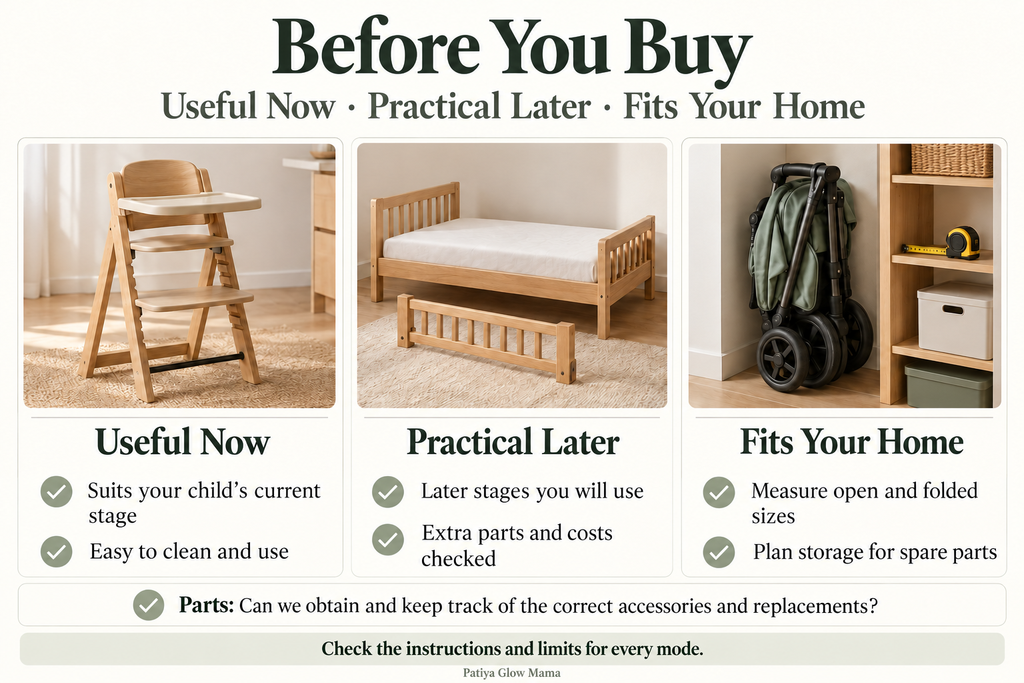
Before adding a grow-with-baby product to your cart, ask:
- Useful now: Does it suit my child’s current stage and our daily routines?
- Relevant later: Which future configurations would we realistically use?
- Complete cost: What extra parts are required, and are they included?
- Space: Will the setups we want fit our home, car and storage areas?
- Daily effort: How easy is it to clean, move, adjust and convert?
- Limits: What are the requirements and stopping points for each mode?
- Parts: Can we obtain and keep track of the correct accessories and replacements?
If a listing leaves a question unanswered, check the manual or ask the manufacturer before buying.
Choose for the Stages Your Family Will Actually Use
Adaptable baby gear can be a thoughtful purchase when it works well today and offers later stages you’re likely to need. Its value comes from those useful years of service, including the space, effort and extra costs involved.
You don’t need to predict your child’s entire childhood to make a good decision. Start with your current needs, look carefully at the next likely stage and give yourself room to choose differently later.
The best grow-with-baby product is one that keeps earning its place in your family’s everyday life.
Pingback: Silicone Bib vs Sleeved Bib: Match It to the Mess