

A pimple always seems to appear when you would rather it didn’t—just before work, an outing or a day when you finally feel good about your skin. You notice it in the mirror, resist the urge to squeeze and start looking for something that might help.
Pimple patches look like an easy option. But once you start shopping, the choice becomes less straightforward. There are clear dots, colorful stars, patches with salicylic acid and others with tiny dissolving darts. Some packs contain a handful; others contain enough to last for months.
Before choosing one, it helps to know what you want it to do. Cover a spot so you stop touching it? Absorb fluid from a draining blemish? Stay discreet while you go about your day? Those details matter more than an impressive promise on the box.
What do Pimple Patches actually do?
Many pimple patches are made with hydro-colloid, an absorbent material also used in wound dressings. A plain hydro-colloid patch absorbs fluid from a draining blemish and keeps the area covered. For anyone who finds themselves touching a spot without thinking, that covering can be useful in its own right.
Cleveland Clinic explains that pimple patches work best on open, oozing pimples. They offer less help with closed bumps, blackheads and deeper whiteheads, and they do not prevent new acne from developing.
There is some research behind them. A small randomized study involving 20 people found greater improvement in acne severity and inflammation with hydro-colloid dressings than with ordinary skin tape over several days. The study was small and short, however, so it cannot tell us that every patch on the shelf will produce the same result.
A patch may help with an individual blemish. Whether that spot looks better by morning will depend on more than the promise printed on the packet.
1. Start with the spot you have
It is easy to buy a patch because someone else had good results with it. But their pimple may have been quite different from yours.
A surface pimple with a visible pus-filled head is different from a closed bump beneath the skin. A deep, painful lump is different again. A plain absorbent patch needs fluid it can reach, which is why a draining blemish is a better match than a blackhead or a closed bump.
Do not squeeze or puncture a pimple to get it ready for a patch. The American Academy of Dermatology’s acne-care guidance warns that picking and popping can delay clearing and increase the risk of scarring and dark marks.
Check what the product says it is intended for, then decide whether that description matches the spot you want to cover.
2. Read beyond the words “Pimple Patch”
Products sold under the same name can have different ingredients and designs. The front of the pack may look simple; the ingredient list usually tells you more.
Plain hydro-colloid patches
As an Amazon Associate I earn from qualifying purchases
These absorb fluid and cover the blemish without an added acne medicine. Hero Cosmetics’ Mighty Patch Original, for example, is described by its manufacturer as a drug-free hydro-colloid patch.
If you mainly want to cover a suitable spot and keep your fingers away, a plain patch is a sensible place to begin your comparison.
Patches with added ingredients
Some patches contain salicylic acid, tea tree oil or other ingredients. You may recognize these from products you already use, but their presence does not automatically make a patch a better choice.
Cleveland Clinic cautions that added ingredients and patch adhesives can irritate some people’s skin. Even a patch without acne medication may cause problems if you are sensitive to the adhesive.
Think about your own experience. If an ingredient or adhesive has caused a reaction before, that matters more than a reassuring claim on the packaging.
Microdart patches
Microdart patches have tiny dissolving projections designed to deliver ingredients into the skin. They are often marketed for early-stage blemishes.
Peach Slices Deep Blemish Microdarts, for example, contain salicylic acid, niacinamide and other ingredients. The manufacturer positions them for blemishes below the surface. That tells you what the product is designed for, but it does not establish that it will work better than a plain patch for every buyer.
When comparing these with ordinary hydro-colloid dots, look at the intended use, ingredients and price together.
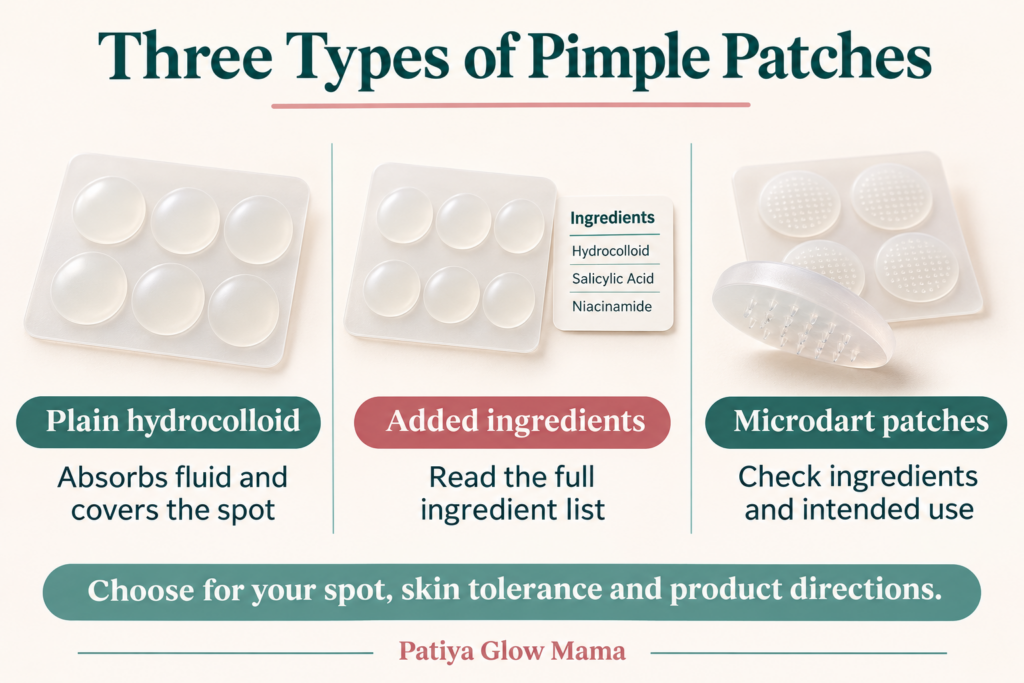
Illustrative examples. Ingredients and designs vary by product.
3. Check the sizes inside the pack
A big pack can seem like good value until you realize that you keep reaching for one size and leaving the rest behind.
Look for the actual measurements. Product photographs can make it difficult to judge how much skin a patch will cover. As an example, Mighty Patch Original lists 12 mm patches in both its 36-count and 72-count packs.
A mixed-size pack gives you options. A pack containing one size may suit you better if that is the size you usually need.
Before buying, ask yourself: How many of these patches would I actually use?
4. Choose a finish you feel comfortable wearing
Some people happily wear a colorful star to the grocery store. Others would prefer a clear dot that draws as little attention as possible. Either preference is reasonable.
If you plan to wear patches during the day, look closely at photographs showing their thickness, finish and edges. A patch described as “invisible” may still be noticeable on your skin, especially at close range.
For evening or overnight use, appearance may matter much less. You might prefer to put that part of your budget toward a useful size or a formula you already know suits you.
There is nothing wrong with choosing a design you enjoy. Just give the ingredients and directions as much attention as the shape.
5. Make sure the wear time fits your routine
Read the directions before buying, particularly if you expect to wear a patch for only a short time.
For instance, Hero instructs users to apply Mighty Patch Original to clean, dry skin and remove it after six to eight hours. Those are the directions for that product; another patch may have different instructions.
Check how to prepare your skin, how long to leave the patch on and when to remove or replace it. Read any warnings and look for guidance about using it alongside other skincare products.
If the directions are unclear on a shopping listing, check the manufacturer’s website before making your choice.
6. Work out what you are paying per useful patch
Pack prices can be misleading when the quantities are different. A quick calculation helps:
Pack price ÷ number of patches = price per patch
For example, a hypothetical $6 pack containing 24 patches costs $0.25 per patch. A $10 pack containing 60 costs about $0.17 per patch.
The second pack is cheaper per patch, but it is only better value if you will use it. Consider the sizes included, the formula and whether you like wearing that particular product.
If you are trying a patch for the first time, a smaller pack may be worth buying before you commit to a larger supply.
Also compare products with similar purposes. A plain hydro-colloid dot and a microdart patch containing several added ingredients are different products, even when they sit next to each other on the shelf.
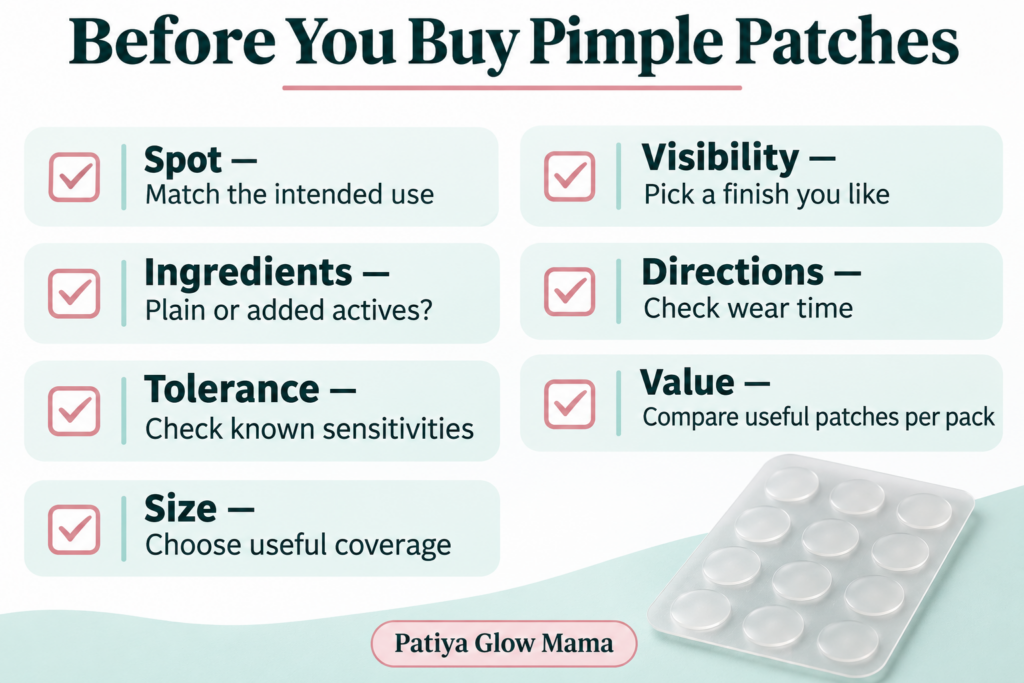
A Quick before-you-buy checklist
Before adding a pack to your basket, check:
- The spot: Does the product’s intended use match the blemish?
- The ingredients: Is it plain hydro-colloid or does it contain added ingredients?
- Your skin: Have you reacted to any of the ingredients or to adhesives before?
- The size: Will you use the sizes included?
- The appearance: Would you feel comfortable wearing it?
- The directions: Does the recommended wear time fit your routine?
- The value: What are you paying for the patches you are likely to use?
You do not need the pack with the most features. You need one that makes sense for your skin and your routine.
When a patch is not enough
If you keep buying patches for deep, painful spots, it may be time to seek advice about the acne itself.
The American Academy of Dermatology recommends seeing a dermatologist when a deep, painful pimple does not go away or when several deep, painful pimples develop.
For an occasional suitable blemish, a patch can be a handy thing to have available. Choose it with realistic expectations, follow its directions and give the spot a chance to settle without picking at it.