
A facial mist is an easy product to like. A few sprays take seconds, and the promise of calmer skin sounds appealing when your face feels hot after a workout or looks irritated after a long day.
Hypochlorous acid sprays have attracted attention for exactly those reasons. They are often marketed for redness, sensitive skin and breakouts, sometimes with enough promises to make one bottle sound like a complete skincare routine.
There are good reasons to be interested in the ingredient. There are also limits to what we know. Before adding a spray to your basket, here is what to look for.
What is hypochlorous acid?
Hypochlorous acid, usually shortened to HOCl, is a compound your body makes as part of its immune response. Manufacturers also produce it for skincare, wound-care products and household disinfectants.
Cleveland Clinic’s dermatology guidance explains that HOCl has antimicrobial properties and can be gentle on skin when used in an appropriate formulation.
Despite its name, hypochlorous acid serves a different purpose from exfoliating acids such as glycolic or salicylic acid. You would not choose a hypochlorous acid mist expecting the same exfoliating effect.
What can a hypochlorous acid spray do for your skin?
It may help soothe irritation
Some facial sprays are formulated to help calm visible redness and irritation. Cleveland Clinic describes HOCl as generally well tolerated, though that does not rule out an individual reaction.
A spray may therefore appeal to someone who wants a simple soothing step. Whether it helps will depend on the product and what is causing the irritation.
The acne research is encouraging, but limited
HOCl’s antimicrobial properties help explain the interest in using it for acne-prone skin. Still, an ingredient’s ability to act against microbes does not tell us how reliably a bottle of facial mist will improve breakouts.
A randomized clinical trial investigated a super oxidized solution for mild-to-moderate inflammatory acne. A separate pilot study involving 20 participants examined proprietary HOCl liquid and gel formulations over 12 weeks.
These studies offer reasons for further research. They tested preparations, however, and the small pilot had no placebo group. Therefore, we cannot assume that every consumer spray will deliver the same results.
The American Academy of Dermatology’s acne guideline summary recommends treatments including benzoyl peroxide and topical retinoids. HOCl is not among the treatments listed on that page.
If you already have an acne treatment plan, keep that in mind when considering a spray. It may be an extra step, but the evidence does not justify replacing established treatment with it.
Eczema claims deserve the same care
A small study involving 22 children with atopic dermatitis reported improvements in bacterial counts and eczema severity after one week of treatment with acid electrolytic water. That finding is interesting, but the study was short and used a specific preparation. It does not establish that a facial spray bought today will treat eczema.
For someone managing a diagnosed skin condition, any new mist needs to fit around their existing care.
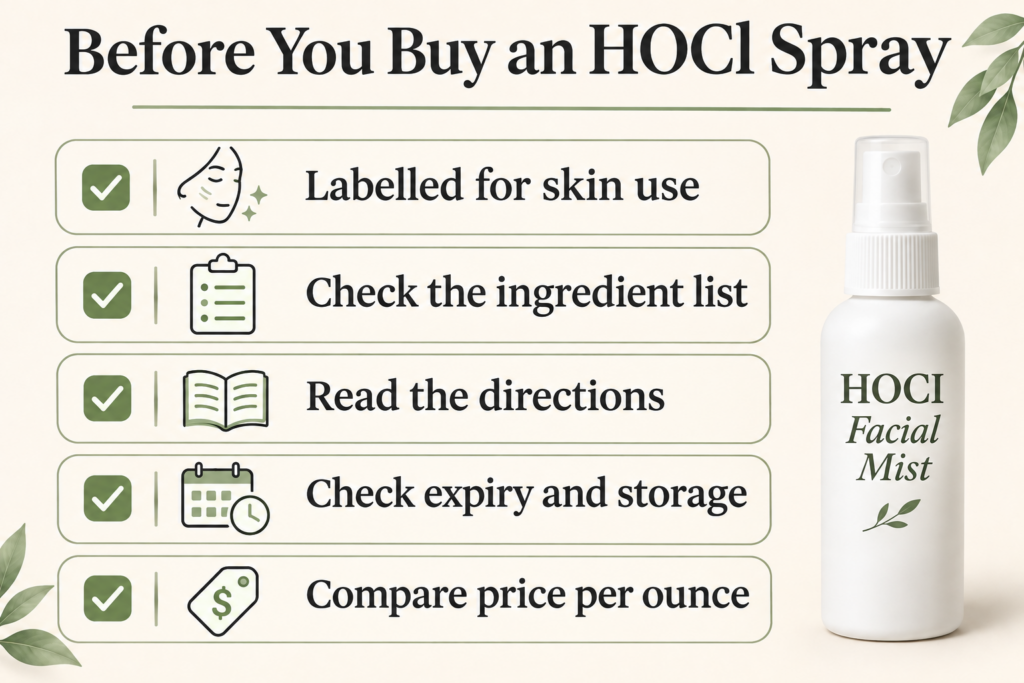
Five things to check before buying
1. Make sure it is intended for skin
This is the first detail to check, particularly when shopping online.
Hypochlorous acid is used in both skincare and household cleaning products. Cleveland Clinic advises using each product only for its intended purpose. A surface disinfectant is not interchangeable with a facial spray.
Look for clear facial or skin-use directions on the actual product. Do not rely on the ingredient name or a seller’s broad description.
2. Read the full ingredient list
Some HOCl sprays have very short ingredient lists. Tower 28 SOS Rescue Spray, for example, lists water, sodium chloride and hypochlorous acid.
That makes the formula easy to check, especially if you know which ingredients your skin dislikes. A short list alone does not guarantee a good match, though.
Cleveland Clinic suggests considering fragrance-free formulas, particularly for sensitive skin. Check the packaging you receive as well, since formulas can change.
3. Look for clear product information
Some brands disclose the HOCl concentration and pH. Briotech’s Topical Skin Spray lists a concentration of 0.014%, equivalent to 140 parts per million.
Disclosure is helpful, but a higher number is not, by itself, a reason to buy. Concentration alone cannot establish which finished product will suit your skin best.
You should also be able to find straightforward directions, precautions and storage guidance. If the listing leaves basic questions unanswered, check the manufacturer’s website before ordering.
4. Check how long it lasts and where to keep it
A spray you plan to carry around needs a little thought about storage.
Briotech states that its personal-care products remain stable for up to one year and recommends using them within six months of opening for optimal performance. It advises storage in a cool, dry place away from direct sunlight.
Those instructions apply to Briotech’s products. Another brand may give different guidance, so check the expiry date and any period-after-opening instructions on your own bottle.
5. Choose a size you will finish
A large refill can look economical when you compare the price per fluid ounce. It is less useful if much of it remains when the recommended use period ends.
For a first purchase, a smaller bottle gives you time to see whether you like the spray and reach for it regularly.
Compare the unit price but also consider how often you expect to use it and how long it will last after opening. If buying a refill, follow the manufacturer’s refilling instructions.
How do you use a hypochlorous acid spray?

The directions depend on the product.
Tower 28 recommends applying SOS Rescue Spray to dry, freshly cleansed skin morning and evening, with additional use throughout the day if needed. For people using actives such as vitamin C, the brand advises applying its spray first and letting it dry fully.
Briotech suggests using its Topical Skin Spray after cleansing or throughout the day. It also recommends a patch test before introducing the product.
Use these as examples of how directions can vary. Follow the instructions for the bottle you choose rather than borrowing a routine from another brand.
What about sensitive skin and the eye area?
Even a product described as gentle can disagree with your skin. Patch test before making it a regular part of your routine and stop using it if irritation develops.
Cleveland Clinic advises avoiding contact with the eyes and not swallowing the product. The existence of specialized HOCl eye-care products does not make an ordinary facial mist suitable for spraying into your eyes. Persistent or worsening redness, itching or breakouts are reasons to seek professional advice.
Is it worth adding to your routine?
A hypochlorous acid spray may be worth considering if you want an optional soothing step and have realistic expectations about what it might do.
If your skin is comfortable and your routine already works, there is no need to add one simply because it keeps appearing in your feed.
Before buying, check the intended use, ingredients, directions, storage requirements and expiry. Then choose a bottle size that makes sense for your budget and habits. Those details will help you make a more useful purchase than promises of perfect skin.